Just us what?

May. 5th, 2026 06:48 pm[personal profile] shadowhive
shadowhive: (BB-8 Thumbs up)
Belated happy Star Wars day for yesterday! (Though I know people call today Revenge Of The 5th so it kinda counts)

I didn’t do much Star Wars related yesterday due to heading to the cinema. I did do some Lego Star Wars free play levels (from Episode II) before heading out and when I got back I did a little on Fortnite (thou* not the Star Wars modes). I have finally got galaxy of heroes to work again it just sucks I missed out on the Andor era but at least it’s in time for the new one.

I did watch the finale of Mail Shadow Lord when I got back, no spoilers but it was pretty great though also a bit sad. I do feel bad for Maul cause of all that which is wild to think about really.

I was thinking of building the Lego X-Wing yesterday but I just had no time. (If I’d not gone out I’d have done it probably.) I did do the little Razor Crest Sunday which was a clever build for something so small, as well as Cobb Vanth’s speeder which looks so cool. Yeah it’s out of scale but that doesn’t matter much to me it looks so nice.

But anyway!

Yesterday I ended up going to the cinema for The Sheep Detectives and Hokum. I went straight to the cinema but it was pretty busy when I got there so I missed most of the sheep detective trailers. (And all the ones for Hokum were repeats alas I expected at least one new one, or even to switch Passenger for the newer one)

Thoughts on both under the cut, there won’t be spoilers for The Sheep Detectives (cause murder mystery) but there might be some for Hokum. (Also there’s unexpected cuteness too)

Read more... )

Next cinema trip might be next week for Obsession (and to use a Burger King code I got sent) then it’s the Mandalorian and Grogu the week after!

Today, as mentioned, I built up the New Republic X-Wing, which was a pretty cool build (and yay getting Colonel Ward!) annoyingly one of the parts has flew off (a bit for one of the laser cannons) and I can’t figure out where it’s gone. So one of the four is a bit shorter than the others,

I might put thoughts for Warning From Space in the next post (I was here but I’m feeling a lil tired so…).

Now I’m gonna rest a bit and then… I’m not sure.
twistedchick: watercolor painting of coffee cup on wood table (Default)
There's a new movie on The Odyssey coming out on July 17. This link has the cast list and a preview.

I can't say for sure, but I have a hunch Christopher Nolan may be doing much of it right. Anne Hathaway is Penelope, Tom Holland is Telemachos. I have minor arguments about Nolan's choice for Odysseus, Matt Damon, but with that beard he looks less Irish, and he does have the build to carry it off. Robert Pattinson looks like a thug as the head suitor. Zendaya as Athene. Charlise Theron as Calypso. And that's not even a third of the cast list.

The one thing I'm withholding judgment on, and hoping against hope that Nolan et al get right, is Penelope. She is the queen of Ithaka, in a misogynistic environment, but historically (or literally, from the literature) she was born and raised in Sparta, where the girls learn to carry weapons and fight with the boys, and are raised as equals to the men. Helen of Sparta was probably a cousin. I hope they bring out her ability to resist (and not just by weaving a cobweb shroud for her father-in-law who isn't dead). She isn't a doormat; she is an armed fortress.

For this, I'll go back to a theater.

Books read, April 2026

May. 5th, 2026 05:40 pm[personal profile] swan_tower
swan_tower: (Default)
Painted Devils, Margaret Owen. Second of the Little Thieves trilogy, which I started last month and promptly fell in love with.

Most trilogies, having clearly established a romantic relationship in the first book, would immediately start the second book by finding some way to break up the pair or otherwise put them on the outs with each other, so as to maintain some kind of tension in that plotline. I found it striking how thoroughly Owens does not do that: yes, there are multiple factors pushing the two of them apart, but they talk to each other and work through those problems and then a new problem comes along and they keep doing what it takes to deal with each one in turn. Meanwhile the plot has a fresh premise -- instead of trying to con her way to a fortune, Vanja has inadvertently created a cult -- and the structure gives that plot occasion to roam more widely than the single-city setting of the first book. The ending was the good sort of frustrating, where I yelled AUGH and then immediately checked out the third installment in ebook so I could run a search for a certain character's name and reassure myself that they show up enough in the story that I could hope for them to eat dirt the way I really wanted them to do. The only reason I didn't read the third book right away was my usual policy of trying to space out volumes of a series to keep from overdosing.

Ancient Night, David Bowles, ill. David Alvarez. I knew this was an illustrated book, but I didn't realize just how short it is. Very much a picture book rather than a book with pictures, relating a Mexican myth about the sun and the moon.

The Notebook: A History of Thinking on Paper, Roland Allen. This is the kind of oddball niche history I'm sometimes very much in a mood for. Allen does his best to approach the subject topically (rather than chronologically, which would be well-nigh useless), starting with things like the advent of accounting ledgers and ranging through how families, artists, musicians, naturalists, housewives, writers, and people dealing with traumatic experiences have used them for different purposes. He also touches on the effect of technology: the notebook itself is dependent on paper, but creating things like lined pages affected how people use them. And then in turn, of course, there's digital technology, which has reduced our use of notebooks -- reduced, but not eliminated. The final section delves briefly into the neuroscience of how devices like notebooks act as an accessory to the brain, effectively making part of it live outside our bodies.

Emperor of Rome: Ruling the Ancient Roman World, Mary Beard. As usual, Mary Beard is extremely readable -- even when, as is the case here, her topic is inherently fuzzy. This is not a chronological or biographical approach to individual Roman emperors, though those elements appear in passing; instead, it's an attempt to figure out what it meant to be the emperor of Rome.

This is harder than you might think to pin down, because there's a ton we simply do not and probably never will know, like how and where exactly the business of government was carried out. (We have vague outlines, but nothing resembling an org chart, or even a map of how the Palatine palace was used.) And when it comes to the emperors as people, Beard does a good job of outlining how the facts we know really add up more to an image of a "good emperor" or a "bad emperor" -- what they were expected to say and do and look like -- than the actual men behind those terms. I particularly liked her argument that the "good" or "bad" reputation had more to do with succession than the actual reign: if you were your predecessor's designated heir, you had a vested interest in depicting him as a benevolent ruler who made wise decisions, whereas if you came to the throne after a bloody civil war, it was much better for you to depict the previous guy as a corrupt and immoral bastard responsible for all that chaos. We have only shreds of contemporary sources to leaven the later hagiography or demonology, but Beard does the best she can to piece those shreds together into something like a more balanced image.

(Also, I got a poem out of this.)

Into the Riverlands, Nghi Vo. Third in the Singing Hills Cycle, though this is not a series that requires you to read them in order. I think this one might be my favorite so far, as Chih grapples with both violence and the fact that you can never know everything about a person. I do, however, continue to have the niggling feeling that I would like these novellas to be longer, so they can dig a little deeper into the tasty meat at hand. They don't need to be a hundred thousand words long -- that would probably overstay the welcome -- but the sort of short novel Tachyon publishes might be ideal.

A Lady Compromised, Darcie Wilde. Fourth in the Regency-set Rosalind Thorne mystery series, which is not the Useful Woman series about Rosalind Thorne. (I will probably at some point poke my nose into that one and see if it's a sequel series to this one or what.)

There's been enough of a gap since I read the previous ones that I can't say for sure if this packs an extra ten pounds of material into the sack, but that's definitely the impression I got. A duel that never happened because one combatant was murdered first, marital intrigues, ethnic tensions, land improvements, the possible rekindling of a romance, and a background strand of blackmail continued on from a previous book . . . it's a lot! I think the ending came together a touch too easily, but that's counterbalanced by characters being put through a brief physical and emotional wringer. Looks like there's one more after this, before I investigate that other series.

Fall of Civilizations: Stories of Greatness and Decline, Paul Cooper. Right at the outset, Cooper acknowledges that he's not trying to assemble a grand analytical theory of why civilizations collapse. (He defines that not as portions breaking away, a la decolonization, but as a full-on crash: population takes a nosedive, economy craters, cities are destroyed, etc.) I understand why not -- this is an outgrowth of his podcast, and goes into the box of "pop culture history underpinned by research" rather than a major academic work -- but it does mean that the component chapters are mostly just potted histories of the civilizations he's looking at, rather than anything deeper.

I don't mind the potted histories, though! Especially for the ones I'm not very familiar with. He divides the book into three sections: the ancient world (Sumerians, Late Bronze Age Collapse, Assyria, Carthage, Han China, Roman Britain), the middle age (Maya, Khmer, Byzantium, Vijayanagara), and "worlds collide" (Songhai, Aztecs, Inca, Easter Island). I should note, though, that where I am familiar with the material, I can see Cooper sometimes accepting a little too readily the standard line on a certain topic, only mentioning in passing -- or omitting entirely -- a more nuanced view. Having read Cline's After 1177 B.C. last fall, for example, I raised an eyebrow at Cooper crediting a "Dorian invasion" for the breakdown of Mycenean civilization during the Late Bronze Age Collapse -- despite Cline being one of the sources Cooper references here! And I read the Carthage chapter right after Bret Devereaux started his series of posts on Carthage, in which one of the first things he (I think convincingly) debunks is the notion, repeated here by Cooper, that Carthaginian citizens rarely fought as soldiers for their own land.

Which is to say, this is the kind of book that's a better starting point than a stopping point. But it's still an interesting starting point! I appreciate the breadth of its scope, and even if Cooper doesn't set out to do macro analysis, you can still see for yourself a number of patterns in the data. I did side-eye the ending a bit, though, where he first decries "doomerism" about our own situation . . . then proceeds to sketch out an extremely doomy scenario of what global civilizational collapse might look like.

(Got a poem out of this one, too. Though not that depressing last bit.)

The Iron Garden Sutra, A.D. Sui. I start a lot more SF novels than I finish, simply because a premise will sound interesting and then I remember that SF is not as much my cuppa as fantasy. Here, though, I was particularly interested in the monastic protagonist -- shocker, that's on my mind right now. Plus the scenario (investigating a derelict generation ship) lands squarely atop my interest in Big Dumb Object stories, so I was very much on board.

And I did enjoy it, though I think Vessel Iris was a little too dissociated from his own troubling emotions for me to be quite as gut-punched as I wanted to be about some of the developments. There's good in-story reason for it, but at times it started to feel like the narration was hiding information from me that the point of view knew for a little too long. Still, I will be keeping an eye out for the sequel -- which it does have, though this book wraps up fine if you don't mind ending on a bittersweet note.

The Outlaw’s Tale, Margaret Frazer. Third of the Dame Frevisse medieval mysteries. I know it's inevitable that sooner or later the story would move outside the convent, but I'm a little sad to see it happen so soon, as I enjoyed the exploration of what it was like to live under the Benedictine rule. Parts of that remain here -- Frevisse feels guilty when her investigation causes her to repeatedly miss scheduled prayers, and is extremely not okay with the prospect of being seen by a man while not dressed in her habit -- but it's not the same.

Frazer remains, however, interested in the textural details of life in that period, and in neither romanticizing them nor (to use a later SF/F term) being grimdark about them: things like how miserable it would be to live out in the woods when you can't even reliably keep the rain off your head. The premise here is that Frevisse's cousin, outlawed years ago for accidentally killing a man in a fight, wants her to leverage her connections to get him a pardon so he can stop being stuck with an outlaw's unromantic life.

I was a little startled to find how not sympathetic the cousin is. He's the kind of man who can turn on the charm for Frevisse (because he wants her help), but he's an asshole to everyone else. And so, when the murder inevitably happens -- something like halfway through the book! -- he's the natural suspect, which means (by the logic of murder mysteries) he's the second least likely culprit after Frevisse herself. I liked how that resolved in the end.

The Killing Spell, Shay Kauwe. I've been excited for this book ever since I met the author briefly at Worldcon! I knew from that conversation that it was about language-based magic, and specifically about the author's own experience with Hawaiian, which was enough to sell me on the premise; turns out that it delves into how different languages are suited to different kinds of magic, and furthermore that poetry is often integral to making spells work! So, yeah, sufficiently far up my alley that I might need to see a doctor about that . . .

This is a very post apocalyptic setting, but I appreciated that while the apocalypse clearly chimes with climate fiction, it's not straightforwardly mundane: an event called the Flood not only sank the Hawaiian Islands very rapidly, but brought magic back into the world. That was long enough ago that the U.S. has essentially collapsed, leaving city-states defending themselves against magical monsters; the Hawaiian survivors are clinging to semi-independent existence outside of an L.A. ruled by a council of magicians representing different approved languages.

Plot-wise, it's a murder mystery where the protagonist gets roped in because the victim seems to have been killed by a Hawaiian-language spell, but in a place very few people can access. It moves at the thriller/urban fantasy-type rapid clip where the characters don't get much breathing room between events -- which means there's not as much time as I would have liked spent on the art of smithing spells, whether that's Kea wrestling with a Russian-language spell sent awry by the lack of good rhymes for a crucial word, or attempting to create a new signature Hawaiian-language spell for her family so she can join the council of Hawaiian elders who rule their enclave. But then, I would quite happily have read entire chapters of that! So perhaps I am not the best judge. :-P It is still very much my kind of book, and I hope I'm right about the vibe I got from the ending, that this plot is done but there could be more in the future.

Pirate Enlightenment, or the Real Libertalia, David Graeber, narr. Roger Davis. Probably I should not have listened to this one in ebook. I was lured in by its brief length (five hours; as Graeber says in the introduction, it's an overgrown chapter of another book split off on its own because "everybody hates a long chapter but loves a short book"), but given my complete lack of familiarity with Malagasy names, I might fared better in following the argument here if I could see names like Ratsimilaho and the Betsimisaraka.

Anyway, in the late seventeenth century there was supposedly a democratic pirate kingdom in Madagascar. Graeber's general thesis here is that while "Libertalia" as described never existed, the interaction of European pirate customs with local Malagasy culture -- in particular Malagasy women -- did lead to some interesting dynamics that he considers to be part of the global experiment in Enlightenment and democracy. But I am probably not doing the best job of summarizing that because, per the above, this was not an ideal thing for me to listen to rather than read on the page. What I followed of it, though, was interesting!

Holy Terrors, Margaret Owen. I decided enough of the month had passed for me to go ahead and read the third book. :-P

In this one the story goes full Holy Roman Empire, with an imperial election -- made more complicated by the fact that somebody is murdering the prince-electors. In tandem with that, Owen goes hard on the emotional front, complete with an interpersonal conflict not easily resolved because the problem at its foundation is not one that can be handwaved away. I very much liked how that got resolved in the end. And the metaphysical strand of the story also continues, with the fascinating problem that the Pfennigeist, the persona Vanja has been using for her less than legal activities, has earned enough fame that it's starting to exert its own force on her, whether she wants it to or not. So basically, allllllll the tasty things wrapped up in one excellent package! I highly recommend this to anybody who finds its subject matter appealing. (And the writing is good, too. There's so many good descriptions in here, and quips that heighten rather than kneecapping the emotional weight.)

Owen has another duology I will be eager to check out, once I've given myself another breather.

The Raven Scholar, Antonia Hodgson. More ravens than I was expecting, less scholarship -- but that's okay, because the ravens are great. (Or rather I should say, magnificent.)

Certain things about the premise here have a YA whiff to them, with basically everybody choosing one of eight animal deities to be their patron, and a competition among warrior representatives of each one to see who will be the next emperor. (Also, murder of a candidate: I didn't mean to read two novels about that back to back, but . . . I did.) However, Neema is not at all a teenager, and the plot gets into a lot more political complexity than I normally see in YA-ish competition tales -- generations' worth of it, in fact. I see why some reviews I saw commented on the number of plot twists along the way, but I didn't particularly mind.

Not quite everything here worked for me. I see why there's such a long opening section taking place years before the main action -- it's important that the people and events there carry more weight than a mere summary would be likely to give -- but it did odd things to the story's momentum, and the approach to point of view was not entirely successful for me, either. Hodgson is doing enough that's interesting, though, for me not to get hung up on the stumbles. I'd rather an author swing for the fences and maybe miss a few balls than play it safe all the time.

(originally posted at Swan Tower: https://is.gd/dCkKjj)
yourlibrarian: Dreamwidth Sheep in Green and Yellow (OTH-Dreamwidth Me Colors - soc_puppet)


In this event's first week 15 people stepped forward to donate Dreamwidth points to other site users who wanted to add or try out paid features. Per their pledges we have enough points to gift either 68 people $3 each in points, or fewer people enough points for particular things (such as 6 months of a premium paid account, a rename token, extra icons, etc.).

Now however it's your turn: we need people who would like paid features to step forward! Leave a comment indicating you'd like some Dreamwidth points, or mention what you'd specifically like the points for. (That way I can allot points based on desired purchases). Comments to this post are screened and all you need say is "Points!".

Remember, paid features is the only way to support Dreamwidth financially. Having giftees means we give Dreamwidth financial resources for all they do.

Please also promote this offer in your account and communities if you're not interested in paid features yourself! Read more... )

Please leave a comment by May 14! On May 15 I'll start matching donors with giftees and those leaving comments here should be receiving points by the end of the month.

(Also if you'd still like to donate points, just visit the donor post and comment with the amount there)

Posted by Ask a Manager

Remember the letter-writer wondering if she could take care of her baby during the workday since her job was undemanding? Here’s the update.

Your response gave me a lot to think about, and ultimately I realized that I was completely bored by my job and needed something with more challenge and growth potential. I decided to take a transfer to a more high powered team. It was a lateral move with no pay increase and more work, but a ton of skill building and potential for growth into other higher paying cross-disciplinary teams. I took the transfer about halfway through my pregnancy so I was able to onboard and finish my training before maternity leave. Infant care spots are incredible few and expensive here, so I took a short leave and negotiated a part-time, completely flexible work schedule for when I came back from leave so I could be at home with my baby for the first year.

Professionally this has been the right move for me, and I did fine — some recognition, a few high visibility projects, and good performance reviews. Now two years out, I’m really happy with my decision and love my team and the work I’m doing.

Personally that first year was rough — I was always working or taking care of my baby (something the comments warned me about!) and the stress combined with the isolation of mothering a newborn took a toll on my mental health. I’m glad I did it — I didn’t have great options for infant care, and we made the best of a tough spot. But if I had to do it again, I would try and prioritize my rest. I also realized that the reason I had been able to do my job efficiently was because I had been relying on my memory and executive functioning at work, and new motherhood and lack of sleep made those disappear overnight. That first year was definitely a lesson in grace and lowering expectations.

Thanks for all your advice and the advice of your commenters!

The post update: can I take care of my baby during the workday if my job is undemanding? appeared first on Ask a Manager.

Season of Drabbles fics

May. 5th, 2026 09:05 am[personal profile] sholio
sholio: closeup violin with the words 'private accomplishments' (Biggles-violin)
Season of Drabbles is revealed! I wrote 5 things, and enjoyed being super sneaky about at least a couple of them for a change.

As Sholio:

Orchestral (Biggles, 200 wds)
Biggles/EvS on a music-related "date."

Time and Tide (Star Trek TOS, 700 wds, Spock/McCoy [sort of])
I was hunting around for other people to treat, saw this person mention time loops among their interests, and realized it would be really interesting to try writing a drabble sequence in which each drabble was an iteration of the time loop.

(This was also one of the ones I mentioned that was a fandom I've never written before. Particularly neat in this case since this is far and away one of my oldest "fandoms" - I use that in quotes because I'm not sure if you can call it that when you're as young as I was when I first watched episodes on TV a very long time ago, but it's definitely something I've had feelings about since an early age.)

As AltSholio:

A New Normal (Agent Carter, 100 wds, Jack & Peggy)
My actual assignment, and I had fun with it! Just a bit of post-canon adjustment and banter.

Stay (Biggles, 100 wds, h/c)
H/C fluff for the win.

Second Contact (Project Hail Mary, 300 wds, Grace & Rocky & Adrian)
Grace meeting Adrian. This would be the other fandom I hadn't written before, and probably wouldn't have under my main because there's not likely to be any more of it, but I enjoyed writing this little treat!
delphi: A handwritten note reading "For the New Unicorn" (izzy unicorn)
xposted from [community profile] polyamships for the prompt to write a ship manifesto for a favourite poly ship.


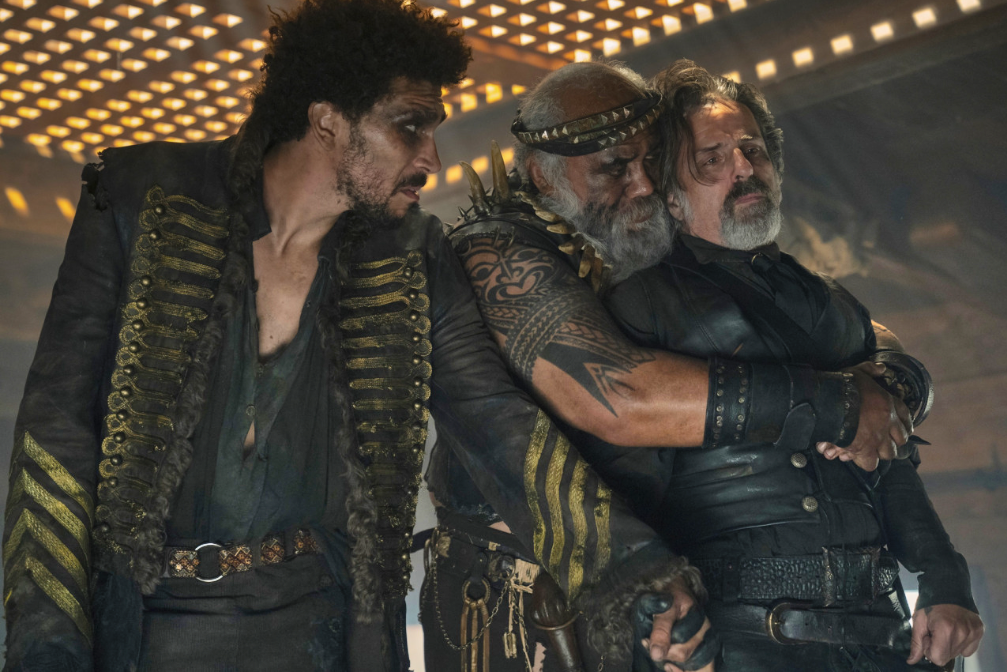
A still from s02e01 of Our Flag Means Death in which Izzy Hands is being bear-hugged from behind by Fang while Frenchie holds his hand, fingers interlaced.
Izzy Hands (right): a man who needs a multi-party introduction to hugging.


I talked about the Feral Five (Archie/Fang/Frenchie/Izzy/Jim) in the previous post about favourite poly ships, but for this manifesto I'd like to expand that further to All Deck on Hands—the inarguably perfect ship name for Izzy Hands and the entire crew of the Revenge.

(And how much do I love being in a fandom where a polycule straying into the double digits has a name and a fanbase?) Exact numbers on this polycule vary based on who's aboard the Revenge when the story's set, but for me, I'm most often adding Lucius Spriggs, Black Pete, Roach, Wee John Feeney, and Oluwande Boodhari to the previous fivesome in a post-canon setting.

But let's rewind.

The Whats and Whys and Hows of All Deck on Hands )

Visuals

A gifset sampler of Izzy with the crew by [tumblr.com profile] userarmand: https://userarmand.tumblr.com/post/736265400421056512/izzy-the-crew

The crew make a new prosthesis for Izzy:


Izzy's drag debut at the crew's celebration for Calypso's Birthday:

Posted by Ask a Manager

A reader writes:

I work at a creative company with 50+ people on staff, about 30 of whom come into the office regularly. It’s a great place to work overall, but I’ll be honest, I’m in a bit of a humbling professional moment. After being laid off from my more senior role earlier this year, I took on a junior position here because, well, times are hard and you do what you have to do.

Part of my current role involves managing the studio space, which includes keeping our small kitchenette tidy and running the dishwasher. I actually don’t mind this, I run the washer every night before I leave and empty it in the morning so there’s always space for dishes. What I do mind is that a subset of my colleagues continue to leave their dirty dishes and cups piled up in the sink despite the fact that a perfectly functional dishwasher is right there.

I’ve already sent a group message asking people to put their dishes directly in the dishwasher instead of leaving them in the sink, and for a while it helped, but old habits are creeping back. I’m now regularly cleaning up after adults who absolutely know better.

Truthfully, I know that cleaning the kitchen is technically part of my job. But having spent years in more senior roles, there’s something that stings about feeling like the office maid for people who can’t be bothered with basic courtesy. I’m aware that might be an ego thing on my part, and I’m trying to keep that in mind, but it’s hard.

My question is: how do I communicate, clearly and professionally, that this behavior needs to stop, without coming across as either a pushover or someone who’s overstepping? Is there a way to escalate this that doesn’t make me look like I’m making a big deal out of dishes? And is there anything I can do to manage my own frustration in the meantime?

This hinges on whether cleaning up other people’s dishes is supposed to be part of your job. In some offices it might be, with the idea that they want other people to be able to get back to their own jobs more quickly or not have to take time out between back-to-back meetings and/or they’ve accepted the reality that if they don’t specifically make it part of someone’s job, the kitchen quickly becomes chaos.

If it’s an intentional part of your job … well, then it’s the job, even if stings. If that’s the case, you have a few options: you can work on seeing it as perfectly dignified work, even though it’s different from the work you’re used to, or you can pitch your boss on making it not part of the job (although that may be challenging if they specifically want someone charged with it so that other people can back to their own jobs more quickly), or you can decide you’re not interested in a job that includes this element and look elsewhere. But if it’s genuinely part of the role and not your colleagues just being thoughtless, you’ve got to accept that as the reality of this position and try not to stew over it.

On the other hand, if it’s not supposed to be part of your job — if people are supposed to deal with their own dishes and you just run the dishwasher at the end of the day and keep the rest of the space clean — that’s different. If that’s the situation … well, you have a battle ahead of you. That’s frequently the case with office kitchens, which often suffer from the tragedy of the commons (where no one feels like it’s really their responsibility to take care of a shared resource). You’re looking for a way to tell people “cut this out” that will actually get through to them and doesn’t involve you melting down in a fit of rage, but as generations of people annoyed by messy office kitchens will tell you, there is no such magic string of words. Instead, realistically, your choices are:

* Continue the cycle where you remind people, they get better for a while, and then they backslide.

* Enlist someone who has the power to lay down the law with your coworkers about this (which they may or may not be willing to do in a way that really has teeth — and in practice, they might not be inclined to hassle a top performer who left a mug in the sink while running between meetings).

* Convince someone above you that the only way to solve this is with more extreme measures, like letting you throw out any dishes that are left in the sink at the end of the day, moving all the dishes left at the end of the day to a “dirty dishes box” where they will eventually get thrown out if not reclaimed, or switching the kitchen to only disposable dishes and utensils (possible, but they’d need to agree the problem is bad enough to warrant that, and there’s an environmental cost to doing that).

* Find a way to make peace with it (even if that’s just deciding that annoying as it is, you like the money you get for dealing with it).

The post my coworkers leave dirty dishes in the sink and expect me to clean them up appeared first on Ask a Manager.

runpunkrun: combat boot, pizza, camo pants = punk  (punk rock girl)
Photograph of things you might take with you, or pick up, on a trip, with added text: Journey & Travel, at Fancake. Items are neatly arranged on a rustic wooden table or door and photographed from above: hat, knapsack, barn coat, worn boots, folding knife, sunglasses, bottle, magnifying glass, as well as various maps, notebooks, pine cones, cameras, lenses, and rolls of 35mm film.[community profile] fancake's theme for May is Journey & Travel! This theme is for fanworks that focus on the journey/travel of it all. That could mean a work that focuses more on the journey than the destination, one where the travel destination is a big part of the work, or, as always, a secret third thing!

If you have any questions about this theme, or the comm, come talk to me!

Posted by Katherine J. Wu

In recent years, the perils of body mass index, or BMI, have become a hobbyhorse for professionals in several fields of medicine and research. For decades, doctors have used BMI to help diagnose and treat obesity, diabetes, and other chronic conditions, even as evidence has accumulated that the metric is a poor proxy for excess fat. BMI factors in height and weight but not actual body composition; many people with high BMIs are the picture of health, and many with “healthy” BMIs are at serious risk of metabolic disease. The case against BMI is strong enough that many in medicine would like to be free of it.

Gripes have been raised, too, about medical guidance that relies on race. Although race can track with some factors that influence health, such as lifestyle and socioeconomic status, its relationship to genetic differences is tenuous: Designations such as “Black” and “Asian” cover so many people, with such varied backgrounds, that they’re essentially meaningless as biological categories. When doctors have used race to assess well-being, they’ve missed diagnoses and discriminated against patients. Experts now widely consider many race-based tools in medicine to be harmful and outdated, and are eager to leave them behind.

But researchers and clinicians still rely deeply on both BMI and race, in some cases at the same time. When screening for type 2 diabetes, for instance, race-sensitive BMI cutoffs identify more at-risk people than either factor alone. And however conflicted experts are over how to use that tool and others like it, finding alternatives comes with its own baggage.

When weighing the risk factors for type 2 diabetes, doctors generally flag a BMI of 25 or higher—what’s usually considered “overweight”—as a factor for further testing. But experts have known for a long time that this universal cutoff makes little sense. The original calculation of BMI arose nearly 200 years ago, was never intended for medical use, and was based on data from primarily white, European populations. And so researchers, clinicians, and policy makers around the world have pushed for people of Asian descent to get that same screening at a lower BMI threshold, of 23. The American Diabetes Association and the U.S. Preventive Services Task Force have supported that guidance for years; the CDC’s online prediabetes test has lower BMI cutoffs for Asian Americans than for people from other backgrounds. In Asian countries such as South Korea and Singapore, the lower threshold has been adopted as the national standard. At this point, the reality for people of Asian descent seems quite clear: “We do know that certain groups would benefit from more aggressive therapy at lower BMI cutoffs,” Fatima Cody Stanford, an obesity-medicine specialist at Massachusetts General Hospital, told me.

In this case, applying a race-and-ethnicity filter may help address some of BMI’s shortcomings. Studies suggest that many people of Asian descentespecially of South Asian descent—might have more trouble regulating their blood sugar than other racial and ethnic groups do, and seem more likely to store fat “in places that it shouldn’t be,” such as around visceral organs, in the abdomen, in the liver, and in muscles, Alka Kanaya, a diabetes researcher at UC San Francisco, told me. That so-called visceral fat seems to drive inflammation and insulin resistance, and has been linked to serious medical issues. But BMI can’t account for the location of fat in the body and so can mask diabetes risk for populations in which bodies might appear thin but have more centralized fat. Using a BMI of 25 to screen for diabetes could mean missing one-third to one-half of Asian Americans with type 2 diabetes; a threshold of 23, meanwhile, could cut that missed proportion in half.

At the same time, racialized cutoffs reveal the drawbacks of relying on race at all. “Asians” is a big group—billions of people—that itself contains immense diversity. And when researchers parse out people of, say, Vietnamese descent from those of Indian, Filipino, Chinese, Korean, or Pacific Islander heritage, they find different risks (without much insight into whether those differences are driven by lifestyle, socioeconomic factors, genetics, or a combination). Not everyone knows their full racial or ethnic makeup; people of mixed backgrounds are one of the fastest-growing demographic groups in the United States. “How do you classify them?” Maria Rosario Araneta, an epidemiologist and a diabetes researcher at UC San Diego, asked me. Ideal screening tools excel both at identifying risky cases and at excluding healthy ones. But lowering the BMI cutoff for people of Asian descent starkly increases the number of patients who are unnecessarily flagged for further testing.

Experts also disagree on what could be used instead of BMI to screen people. Body-composition scans can measure fat directly, but they’re expensive and impractical to use on everyone. Another option could be to screen everyone above a certain age for diabetes, using a fasting glucose test or another test that measures a blood sugar called A1C. But fasting glucose tests—which require, well, fasting—may not come with ideal compliance. And Araneta and her colleagues have found that A1C cutoffs for diagnosing diabetes may need to be reevaluated, especially for certain Asian populations that may develop diabetes at lower levels than people of European descent.

Alternative strategies for estimating excess fat have their challenges too. Goutham Rao, a family physician at the University Hospitals Health System, told me that he favors using waist circumference or waist-height ratio. But other researchers find any tool that relies on measuring waists to be impossibly messy. Even well-trained professionals will sometimes take measurements from different parts of a patient’s midsection; the person being measured, too, can skew the results: “You take a small breath in and you change your waist circumference by two centimeters,” Kanaya said. And research suggests that cutoffs that rely on waist circumference may, yes, also need to take into account a person’s ethnicity or race. “Of course, BMI is not perfect,” George King, the chief scientific officer at the Joslin Diabetes Center, in Boston, told me. “But we don’t really have much else to guide us.”

For now, several researchers told me, race-sensitive BMI risk cutoffs could stand to be used more widely, not less. In the United Kingdom, says Rishi Caleyachetty, a general practitioner and an epidemiologist who has studied BMI, although the National Health Service uses the 23 cutoff for some ethnic populations, including those of Asian descent, those thresholds haven’t been consistently adopted across the country. In the U.S., Stanford said, the Mass General Weight Center still uses a universal set of BMI cutoffs to admit patients, and she has had to overrule those standards in several cases to ensure that certain patients are seen. And many insurance companies have relied on BMI to determine whether they’ll pay for GLP-1 medications, without carving out exceptions for particular racial or ethnic groups that might have distinct risk profiles.

Scientists haven’t been able to rigorously study how much of an impact calls to “screen at 23” have had—in part because Asian Americans weren’t well represented in the U.S.’s National Health and Nutrition Examination Survey, which includes estimates of diabetes prevalence, until 2011. King said he thinks that the available evidence hints at a drop in the prevalence of undiagnosed diabetes in Asian American communities. But one small study from 2022, based on self-reported data on diabetes screening, found no change in diabetes-screening rates among Asian Americans after the change in guidance.


BMI cutoffs that take into account race and ethnicity may be short-lived, as researchers develop better tools and protocols to help people identify and manage chronic metabolic conditions. But BMI is still everywhere for a reason: “No single measure will compete with BMI in simplicity,” Samar El Khoudary, a women’s-health researcher and an epidemiologist at Virginia Commonwealth University’s School of Public Health, told me. Across the board, the researchers I spoke with told me that they understand the serious limitations—and major risks—of overusing or misusing BMI and race, separately or together. But many of them also worry that too hastily casting these categorizations aside could do more harm than good. “To be able to remove it, you need to be able to replace it,” El Khoudary said. And she doesn’t yet see a clear plan for what metric can accomplish that—certainly not one that can also avoid all of BMI’s pitfalls.

spiralsheep: Sheep wearing an eyepatch (Default)
- Books read to end of April 2026, part half of two: 45

39. Paying Guests, by EF Benson, 1929, novel, 4/5

Not as good as Mapp and Lucia, obv, but a similar comedy of manners on a smaller scale and featuring the residents of a superior guesthouse in a 1920s spa town, including far too much detail about the game of bridge, a pop at the cult of Christian Science, a grumpy retired colonel, and happy lesbians ever after. This is a 3.5/5 read for me but I've awarded Benson 4/5 for effort in successfully publishing a lesbian romance with a happy ending in 1929.

I borrowed what appears to be an entirely unauthorised reprint, which contains no copyright information, and fails to credit the cover image, and has a blurb on the back that sounds as if it was written by an international English speaker:
"The story is set around the Wentworth mention" [sic - mansion / pension?] "and its owners and lodgers, usual and recognizable [sp.] Benson's characters [sic]. They are quite unlikable, mainly upper-middle-class English people who came to the Spa to cure their body illnesses [sic], but also to fill the time and escape boredom despite having no passions, interests and work." [/don't hold back, just tell it like it is, lmao]

41. Secret Lives, by EF Benson, 1932, novel, 5/5

If Paying Guests is actually The Lesbian One then this is almost The Gender-Swapping One. A working class spinster is moving up the social ladder through her own hard work and with the assistance of her profit-focussed German publisher, her unWodehousian butler, and a newspaper gossip columnist who isn't what s/he seems. Raises Benson's very versatile flag in territory somewhere between his own Mapp and Lucia, the Jeeves stories, and popular "women's" fiction. This is subtler, more humane, and less viciously satirical than Benson's in/famous earlier novels about social climbing. The author amuses himself, and us, by repeatedly showing that lowbrow populist romantic adventure novels are beloved of socially useful types such as tradesmen and servants, while being mocked by those of a more exclusive social class who aspire to a higher culture despite failing to put in the work necessary for intellectual achievement. There is a perhaps surprising depth in this exploration of the value and ethics of literature, but Benson's novels are often more complex than I remember them and sometimes deeper too. I continue to admire his intricate plotting.

The fictional novel title Julian Beltravers is, of course, a parody of Ernest Maltravers (earnest bad-traverse) by Edward Bulwer Lytton.

Heart's Queen is possibly Queen of Hearts by Wilkie Collins, but there are other contenders, although: "I’m sick to death of novels with an earnest purpose. I’m sick to death of outbursts of eloquence, and large-minded philanthropy, and graphic descriptions, and unsparing anatomy of the human heart, and all that sort of thing."

Couldn't identify Amor Vincit, unless it's Robert Benchley's Love Conquers All which I don't know enough to judge, but love of various kinds does conquer in Secret Lives. And Benchley's humour could have appealed to Benson, "After an author has been dead for some time, it becomes increasingly difficult for his publishers to get out a new book by him each year."

Three quotes )
osprey_archer: (writing)
After a lengthy hiatus, 100 Books That Influenced Me has returned! I reread Matt Bell’s Refuse to Be Done: How to Write and Rewrite a Novel in Three Drafts, and it fit too perfectly into this series to be reviewed anywhere else.

When the urge to reread struck, I actually had a bit of trouble finding this book, because I had misremembered the title as Dare to Be Done. This was, after all, what the book allowed me to do: I was in despair over ever finishing The Sleeping Soldier, which had sprawled into ten massive, messy drafts. Bell’s methods helped me sort this enormous mass of material, organize the pieces, and at long, long last put them together in an order that actually functioned as a story.

These methods are the two strategies that Bell describes in part two of the book, the section about transforming your rough exploratory draft (discussed in part one) into a solidly plotted novel (which you will then polish, polishing techniques described in part three). The first is to make an outline of everything that you’ve already written.

It turns out that it’s much easier to deal with ten drafts worth of material when you’ve reduced all those thousands and thousands of words to outline form. You can see at a glance what scenes you already have, and which scenes must logically come before which other scenes, and which scenes you need to have but haven’t written yet. Then suddenly you’ve got a working outline, which has given you a ton of new interest and enthusiasm, because the project seems so much more possible that you’ve accidentally written a bunch of those new scenes into the outline and simply need to type them up!

The other strategy Bell describes is not to copy and paste from one draft to another, but to retype everything. I scoffed as I read this strategy, but since I was desperate, I decided to give it a try, and goldarnit if it didn’t work.

First of all, although you can copy-paste a scene that doesn’t quite work across ten drafts, if you retype it, you find that you have to fix it.

Second, since the outlining ended up moving a lot of scenes around, almost all the scenes needed some revision anyway, so they weren’t accidentally referencing scenes that now happened later on. Retyping the scenes in order following the outline made this work happen naturally, since I knew what I’d already retyped.

Third, this made it very obvious if there were scenes I still needed to write that I’d missed in the outlining stage.

Absolute convert. Never copy-pasting anything again. The method worked so well that I used it on Sage, similarly a wilderness of many messy sprawling drafts, and transformed it into Diary of a Cranky Bookworm.

I’ve used the second-draft tools in this book most extensively, but since those tools work so well… I mean, I have been having a bit of trouble with the first draft of The Paper Bird. Maybe I should poke through Bell’s first-draft suggestions and give a few of them a try.

fic rec Tuesday

May. 5th, 2026 06:37 am[personal profile] marcicat
marcicat: MB 7532 hours (MB 7532 hours)
A very un-serious Star Wars fic rec to celebrate (belatedly) Star Wars day!

We're Jedi. We've totally got this., by mytimeconsumingsidehobby

“How do a five-year-old and a four-year-old manage to sneak out of the temple in a ship?” Mace muttered to himself.

“With the Force?” the padawan responded, clearly having heard Mace’s rhetorical question.

He sighed.

30 Days of Blake's 7 - day 5

May. 5th, 2026 10:27 pm[personal profile] vilakins
vilakins: (vila blue)
Day 5: Favourite male character

You know the answer to this one: Vila of course!

My favourites in other series have usually been aliens or androids (Spock, Data, Vir, G'Kar, pretty much the whole cast of Farscape), so Vila seemed to be an outlier, but it occurred to me recently that I go for characters who don't fit the norm, like Sheldon Cooper, Wash and Kaylee from Firefly, and Jett Reno. If they're male, then they're not typically so.

Vila stands out in Blake's 7 for being nervous, often openly scared, kind, non-violent, and very funny with it, someone who defies the B7 universe by being himself. He's also the only character who drove me to write for him, because he deserved a lot better than he got.

All the questions are on Tumblr.

Hikago Day

May. 5th, 2026 06:53 pm[personal profile] meteordust
meteordust: (hikaru)
HONDA:
Waya, d'you mind if I come to your Saturday study group?
My sensei doesn't have a group on Saturdays.

WAYA:
Sure. You can all come.

NASE:
Honda and Komiya are strong players, but I'd just slow you guys down.
I'd hate to do that...

WAYA:
How are you gonna get better thinking like that?

- Chapter 130 of Hikaru no Go

***


Some things I've been watching lately:

* Evangelion 3.0: You Can (Not) Redo - The third of the Rebuild of Evangelion movies. It's been so many years since I watched the first two, I have practically no memory of what happened. But this movie drops us into middle of the action along with Shinji, who also has no memory of what happened, so I guess it was fine. Anyway, it delivered exactly what I wanted from an Eva movie: dramatic action sequences, emotionally intense confrontations, even more emotionally intense silences, convoluted apocalyptic mythology, Eva Units unleashing their monstrous side, and lots of Kaworu. (There was even "Ode to Joy".) I could have used less of Shinji making bad choices, but I guess if you put a traumatised teenager into a giant robot, you can't be too surprised. I'm still not sure I understand the entire plot, but that's what I expect from Eva too.

* Star Trek: Starfleet Academy - Star Trek is one of the canons of my heart, but I've never been excited about the idea of a Starfleet Academy show. I mean, cadets go to classes? Maybe take exams? I was so wrong. It turns out how you hook me is to set it in the far future - a thousand years from now - when the galaxy is emerging from an era of chaos and destruction. Starfleet is trying to rebuild itself and the Academy is teaching a new generation, who are the hope of the future. I love the mentors who remember the best of how we can be, and the young people trying to discover who they are and what they stand for. It feels so relevant to our world today, which is a torch that Star Trek has always carried. I loved Season 1. I'm excited for Season 2. And I'm gutted Paramount has already decided there will be no Season 3.

(no subject)

May. 5th, 2026 09:34 am[personal profile] oursin
oursin: Brush the Wandering Hedgehog by the fire (Default)
Happy birthday, [personal profile] catvalente!
thewayne: (Default)
It released Tuesday at midnight, the title is Platform Decay. One thing that's nice about buying mostly ebooks is instant access. :-) The author, Martha Wells, recently announced that the next book may be the last in the series, especially since she only has one more under contract. She said that she's happy where SecUnit is and she doesn't want the series to go on indefinitely, plus she's happily at work on a new fantasy series, of which she has two books out right now.

She also has the Murderbot Apple TV show to work with, we shall see how long that series continues.

This book is clocking in at 170-180 pages.

https://www.polygon.com/murderbot-diaries-series-finale-martha-wells-interview/
sovay: (Sovay: David Owen)
With great disgruntlement, Hestia submitted to the invasion of her sovereign space as I cleaned and restocked the pantry, disposing in the process of many of the shredded paper bags in which she had been pleased to nest and very unfairly folding the unshredded ones into the indispensable bag of bags, out of reach of the mighty paw of kitten. I have been so ill for so long that I have been barely cooking for myself and tired of it: nothing is superabundant, but groceries were included among the errands I spent my day running. The shelves tidily contain cornmeal and jam and tinned fish and soup. [personal profile] spatch organized his ramen. When I have finished cleaning the counters, I will be able to bake something. I just heard a train whistle blowing in the night, which always makes me think of Tom Waits' "Gun Street Girl" (1985). Someday I will eat a seaweed cheese.

Profile

beatrice_otter: Me in red--face not shown (Default)
beatrice_otter

April 2026

S M T W T F S
   1234
56 7891011
1213141516 17 18
19202122232425
2627282930  

Most Popular Tags

Style Credit

Expand Cut Tags

No cut tags
Page generated May. 5th, 2026 05:49 pm
Powered by Dreamwidth Studios